2026-05-01 09:01:51
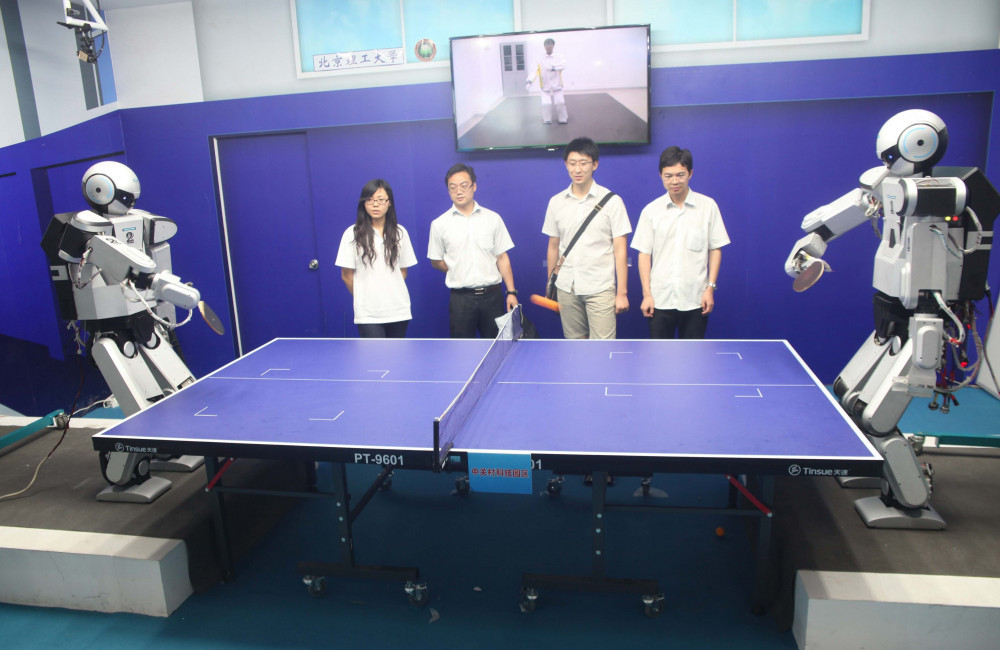
A table tennis-playing robot has demonstrated the ability to defeat elite human ping pong players.
Marking what researchers describe as a breakthrough moment for artificial intelligence in real-world sport, the Sony Ace cyborg, developed by Sony, is a paddle-wielding robotic arm.
It was tested against professional athletes at the company’s headquarters in Tokyo, where an Olympic-size table tennis court was constructed for the experiments.
Equipped with nine high-speed cameras and eight articulated joints, the bot was designed to replicate human-level play while relying on reinforcement learning to improve its performance through experience.
The findings of its game, published in Nature, come amid wider global attention on artificial intelligence following rapid developments in generative AI and robotics.
Sony AI researcher Peter Dürr said: “There’s no way to program a robot by hand to play table tennis. You have to learn how to play from experience.”
The research team behind the project said the robot was capable of matching – and at times surpassing – highly trained human competitors, representing what Sony described as “the first time a robot has achieved human, expert-level play in a commonly played competitive sport in the physical world” and saying it was “a longstanding milestone for AI and robotics research”.
Michael Spranger, president of Sony AI, added the project was designed to address a key limitation in robotics – adaptability.
He said: “Speed is really one of the fundamental issues in robotics today, especially in scenarios or environments that are not fixed.
“We see a lot of robots that are in factories that are very, very fast. But they’re doing the same trajectory over and over again.”
Michael added the aim was to demonstrate that robots could respond dynamically in unpredictable settings, such as a fast-paced sporting match.
He said: “With this technology, we show that it’s actually possible to train robots to be very adaptive and competitive and fast in uncertain environments that constantly change.”
To ensure fairness, the robot’s physical capabilities were calibrated to mirror those of a skilled human athlete, rather than exceed them.
Peter said the system was tested against players who train for at least 20 hours a week, with the robot adhering to official table tennis rules on a standard-sized court.
Michael added: “It’s very easy to build a superhuman table tennis robot. You build a machine that sucks in the ball and shoots it out much faster than a human can return it.
“But that’s not the goal here. The goal is to have some level of comparability, some level of fairness to the human, and win really at the level of AI and the level of decision-making and tactics and, to some extent, skill.”
He said the emphasis was on replicating the strategic elements of the sport rather than relying on mechanical advantages.
Michael said: “The robot cannot just win by hitting the ball faster than any human ever could, but it has to win by actually playing the game.”
Visit Bang Bizarre (main website)